
Insights & Updates
Ready-to-Drink Tea Production Process PDF: Extraction, Clarity & Filling
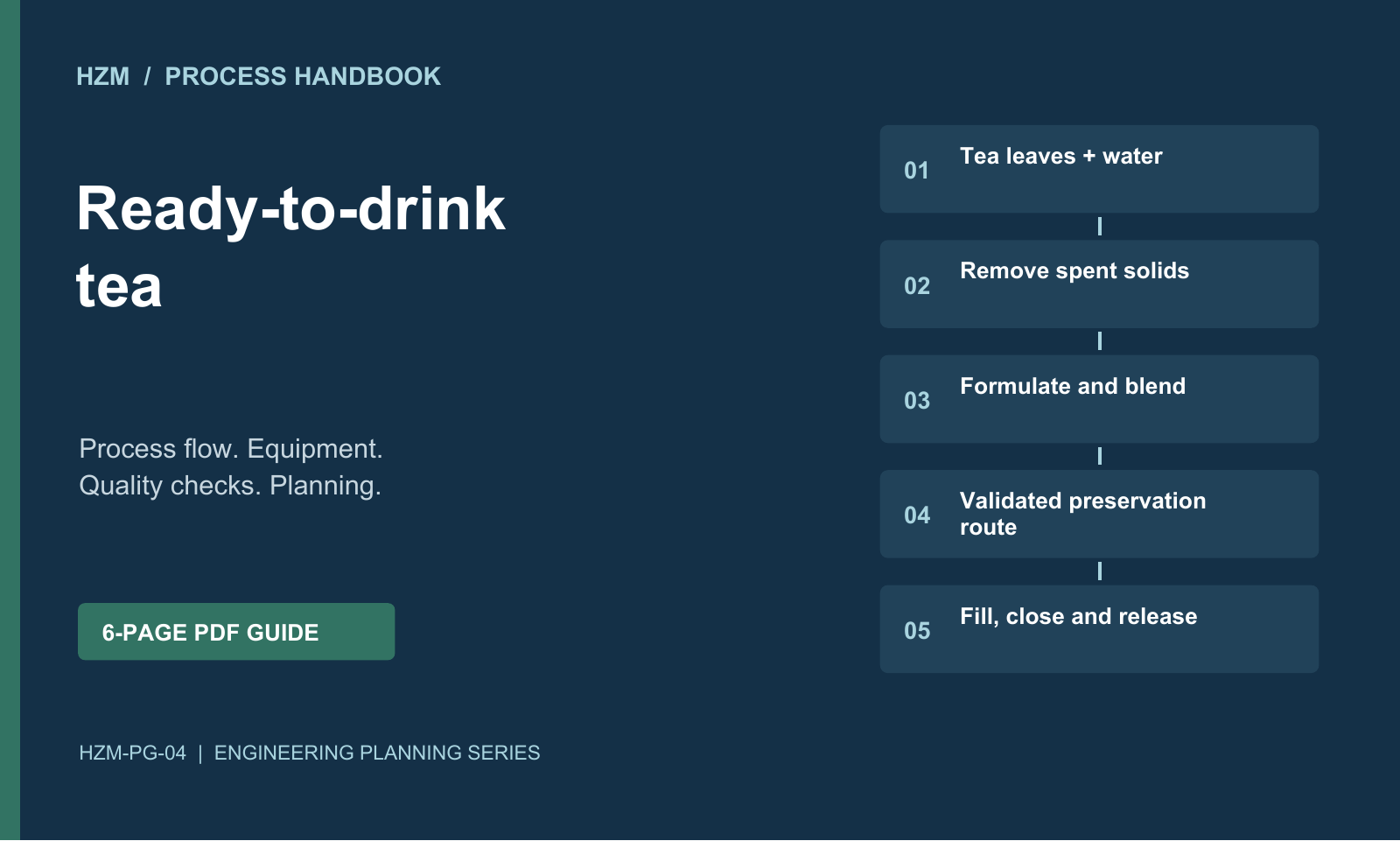
6-page technical guide · Original flow chart · Printable checklists
Scope: Leaf-extracted or extract-based RTD tea. Acidified tea, low-acid tea and milk tea must be evaluated as different product cases.
Process map & product boundaries
Ready-to-drink tea production links extraction and clarification with formulation, preservation and packaging. The best route depends on the tea material, target taste, clarity, recipe and distribution conditions. This downloadable handbook shows how to specify the process and identify the trials needed before ordering an RTD tea line.
Start by separating three cases: an acidified flavored tea, a low-acid unsweetened tea and a milk-containing tea beverage. They may look similar on a filling conveyor but need different product assessments. A tea brewed with hot water is not automatically shelf-stable after bottling. The preservation and filling system must be designed for the finished recipe and intended storage.
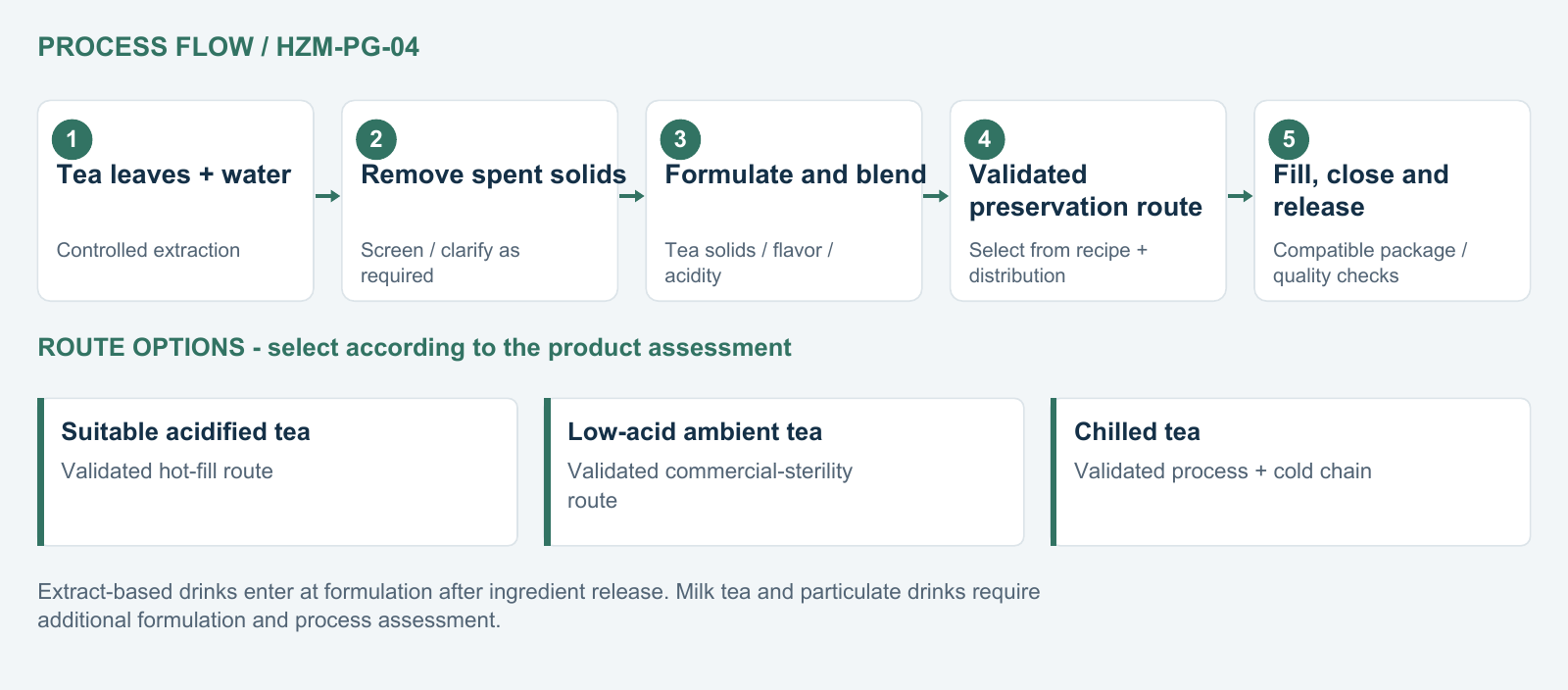
Read the process flow as text
- Tea leaves + water – Controlled extraction
- Remove spent solids – Screen / clarify as required
- Formulate and blend – Tea solids / flavor / acidity
- Validated preservation route – Select from recipe + distribution
- Fill, close and release – Compatible package / quality checks
Extract-based drinks enter at formulation after ingredient release. Milk tea and particulate drinks require additional formulation and process assessment.
Extraction, clarification & formulation
01 / Control leaf and water specifications
Record tea type, supplier, grade, moisture and lot identity. Evaluate water as an ingredient because variation can change extraction and sensory results. Define receiving checks and storage conditions. Keep a retained reference sample of the approved tea material so that a raw-material change is not mistaken for a machine problem.
02 / Develop the extraction window
Extraction depends on time, temperature, tea-to-water ratio and mixing or circulation. Establish the window through trials for the chosen tea. Record both yield and taste; maximizing extracted solids can also increase undesirable bitterness or astringency. Confirm how the equipment reproduces the selected conditions at commercial scale.
03 / Separate spent leaves and manage clarity
Screen or otherwise separate the bulk leaf material before downstream processing. Clarification may be required for a clear tea product. Oxygen exposure and the handling of aggregates influence separation performance, as described in Tetra Pak guidance. Decide whether haze is a defect or part of the intended product appearance before specifying polishing equipment.
04 / Blend to the final recipe
Adjust tea strength and add approved ingredients using a controlled batch record. Evaluate sweetness, acidity, flavor, color and physical stability together. A refractometer reading in sweetened tea reflects more than tea extract solids; use an appropriate method to distinguish extraction performance from added sugar.
05 / Select preservation and packaging
GEA describes extraction, clarification, blending, thermal treatment and filling as parts of an integrated tea process. The exact preservation route must follow the product assessment. Specify the package, process records, distribution conditions and shelf-life evidence together, then plan the appropriate cooling and downstream handling.
Equipment & hygienic plant design
| Process area | Equipment to assess | Design question |
|---|---|---|
| Raw materials | Leaf handling, weighing, ingredient storage | How are lots separated and dust managed? |
| Extraction | Batch or continuous extractor, hot-water supply | How reproducible are contact time and ratio? |
| Separation | Screens, filters or clarification system | What clarity and solids recovery are required? |
| Formulation | Blending tanks and ingredient dosing | How are tea strength and recipe additions verified? |
| Preservation / filling | Product-specific thermal and filling system | What product and package validation is included? |
Provide a separate route for spent leaves, cleaning waste and ingredient packaging so they do not cross protected product or package areas. Access for opening, inspection and cleaning is particularly important around extractors and screens. Estimate the amount and moisture of spent material from pilot trials rather than assuming it behaves like dry tea leaves.
For a factory producing several beverages, define shared and dedicated circuits. Milk ingredients introduce different soil and allergen-control requirements. Strong flavors may need changeover validation. List these cases before finalizing pumps, valves, cleaning programs and the production sequence. A generic blending-tank quotation does not resolve the whole tea process.
Quality targets & product stability
| Characteristic | Suggested evaluation | Use in development |
|---|---|---|
| Extraction consistency | Tea-solids method, batch yield, sensory reference | Set the reproducible brewing window |
| Taste and color | Standardized tasting and color comparison | Detect raw-material or process shifts |
| Clarity / sediment | Visual and instrumental checks at relevant conditions | Assess clarification and storage stability |
| Formulation | Recipe additions, acidity and solids results | Confirm the finished product case |
| Package / process | Process records, seal integrity, microbiological program | Support release and shelf-life validation |
Tea cream, haze and sediment are not interchangeable with microbial spoilage. A clear bottle at the filler can become hazy during storage, while an apparently normal bottle can still require microbiological assessment. Use a structured investigation that separates physical stability, sensory change and food-safety questions. Keep retained samples linked to both the tea lot and the production batch.
Build a storage trial matrix
Test representative batches in the intended package under the defined storage conditions. Record color, clarity, sediment, flavor and package condition at planned intervals. Include the distribution scenarios relevant to the project. Accelerated tests can inform development, but they do not automatically replace real-time evidence.
Keep preservation decisions product-specific
Do not treat a low-acid unsweetened tea as an acidified fruit drink. Evaluate a suitable commercial-sterility process for ambient low-acid products, or another validated preservation and distribution strategy. Milk tea and drinks with particles need further assessment. Avoid assigning one hot-fill temperature to the entire tea category.
Extraction balance & trial checklist
This balance distinguishes tea-derived solids from sugar and other ingredients. A refractometer result on the final sweetened drink cannot be inserted into the calculation as though it represented tea alone. Include extract retained in wet spent leaves, clarification losses, sampling and transfer residues when reconciling the real batch.
Match batch preparation to filling
At an illustrative 10,000 bottles/h and 0.5 L, running liquid demand is 5,000 L/h. A 5,000 L usable finished batch represents one hour of supply before losses. Compare this with extraction, separation, blending, testing and cleaning time. Overlapping operations or parallel equipment may be required, but intermediate holding needs its own hygiene and quality limits.
- Trial representative tea lots and record water quality.
- Compare extraction yield with sensory acceptance, not yield alone.
- Measure losses to spent leaves and clarification residues.
- Evaluate oxygen exposure and the clarity target.
- Test the chosen preservation route with the final recipe and package.
- Confirm cleaning of extractors, screens, valves and transfer lines.
- Demonstrate repeatability across batches and at the required output.
Define what the supplier must demonstrate and what remains the responsibility of the formulation laboratory or process specialist. A successful mechanical run with water does not prove tea extraction yield, flavor retention or shelf life. Include product trials in the project schedule and budget.
Frequently asked questions
Can tea extract replace a leaf extractor?
It can change the front end of the process if the formulation is designed for a purchased extract. Confirm ingredient quality, flavor profile, dosing, solids measurement and storage. Finished-product preservation and packaging still need assessment.
Is milk tea covered by the same process?
No automatic equivalence should be assumed. Milk or plant proteins, fat, allergens and formulation stability affect processing and cleaning. Develop and validate a suitable route for that product family.
Why does tea become cloudy after bottling?
Possible causes include tea-component interactions, water composition, cooling history and inadequate clarification. Check these alongside microbiological results. The correct response depends on the identified cause and the intended appearance.
Can an existing juice filler be reused?
Only after reviewing the tea recipe, preservation route, hygiene level, filling conditions and packaging. Mechanical compatibility alone does not establish microbiological suitability or product stability.
What should be sent with a tea-line inquiry?
Provide tea samples or extract specifications, the finished recipe, target taste and clarity, packaging, output, shelf life, storage conditions, site utilities and cleaning requirements. State whether extraction and product trials must be included.
Continue planning your line
- Automatic Beverage Processing System
- Juice and Tea Filling Line Guide: Product Temperature and Process Selection
- CIP Verification for Beverage Plants: Flow, Temperature, Time and Concentration
- Beverage Plant Utilities Checklist Before Equipment Installation
More downloadable process guides
- Complete Beverage Production Line Process PDF: Flow Chart & Equipment Guide
- Carbonated Soft Drink Production Process PDF: Syrup, Carbonation & Filling
- Juice Hot-Filling Production Process PDF: Flow Chart & Quality Checklist
Talk to our engineering team
Need help planning your packaging line?
Share your product, bottle and capacity requirements for a practical equipment recommendation.
2023-07-21
Functional Tea Beverage Filling Machine: Enhancing Efficiency in Tea Production
The functional tea beverage filling machine is a vital equipment in tea beverage production, characterized by high efficiency, flexibility, and precision to meet different production scales
Learn more2023-09-18
Bottled water production process PDF
The PDF document on the bottled water production process encompasses detailed information on how bottled water is manufactured, including a comprehensive description of production steps, illustrated process diagrams, and in-depth explanations of quality control methods.
Learn more
2023-04-27
The 6 Elements of Tea Beverage Production that Affect Quality
There are several methods to solve the chaos of tea beverages, and the commonly used method is the physical method - cooling the tea soup and removing it with a high-speed centrifuge or filtering it with ultrafiltration to improve the clarity of the tea soup
Learn more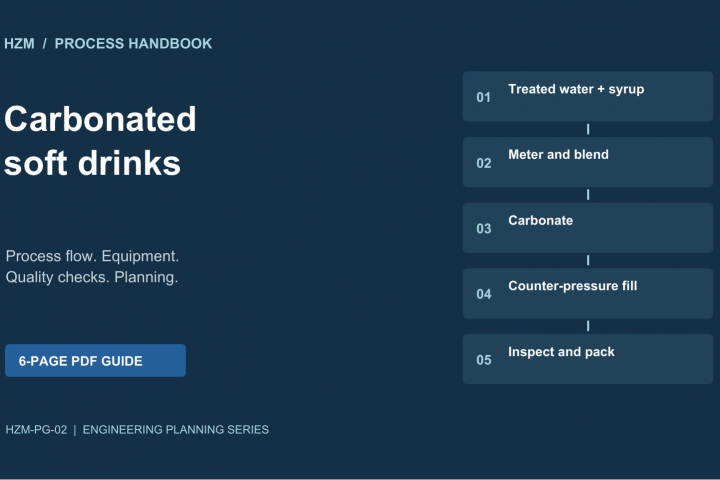
2026-09-21
Carbonated Soft Drink Production Process PDF: Syrup, Carbonation & Filling
Download a carbonated soft drink process PDF covering syrup preparation, blending, carbonation, counter-pressure filling, CO2 checks and line planning.
Learn more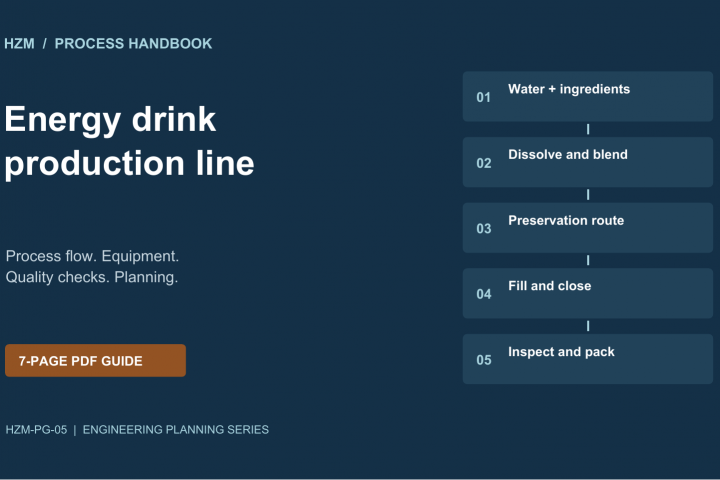
2026-09-21
Energy Drink Production Line Process PDF: Mixing, Filling & Quality Control
Download a complete energy drink production process PDF with ingredient dosing, mixing, carbonated and still routes, filling, equipment photos and quality checks.
Learn more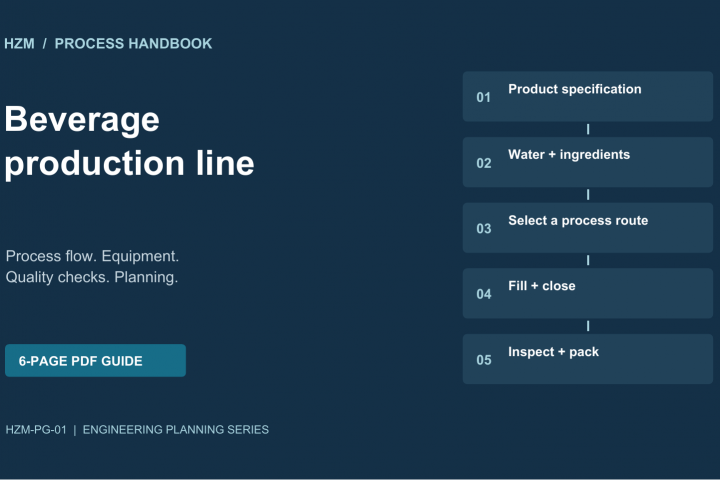
2026-09-21
Complete Beverage Production Line Process PDF: Flow Chart & Equipment Guide
Download a beverage production line process PDF with route-selection diagrams, equipment lists, capacity calculations, utility planning and commissioning checks.
Learn more