
Insights & Updates
Complete Beverage Production Line Process PDF: Flow Chart & Equipment Guide
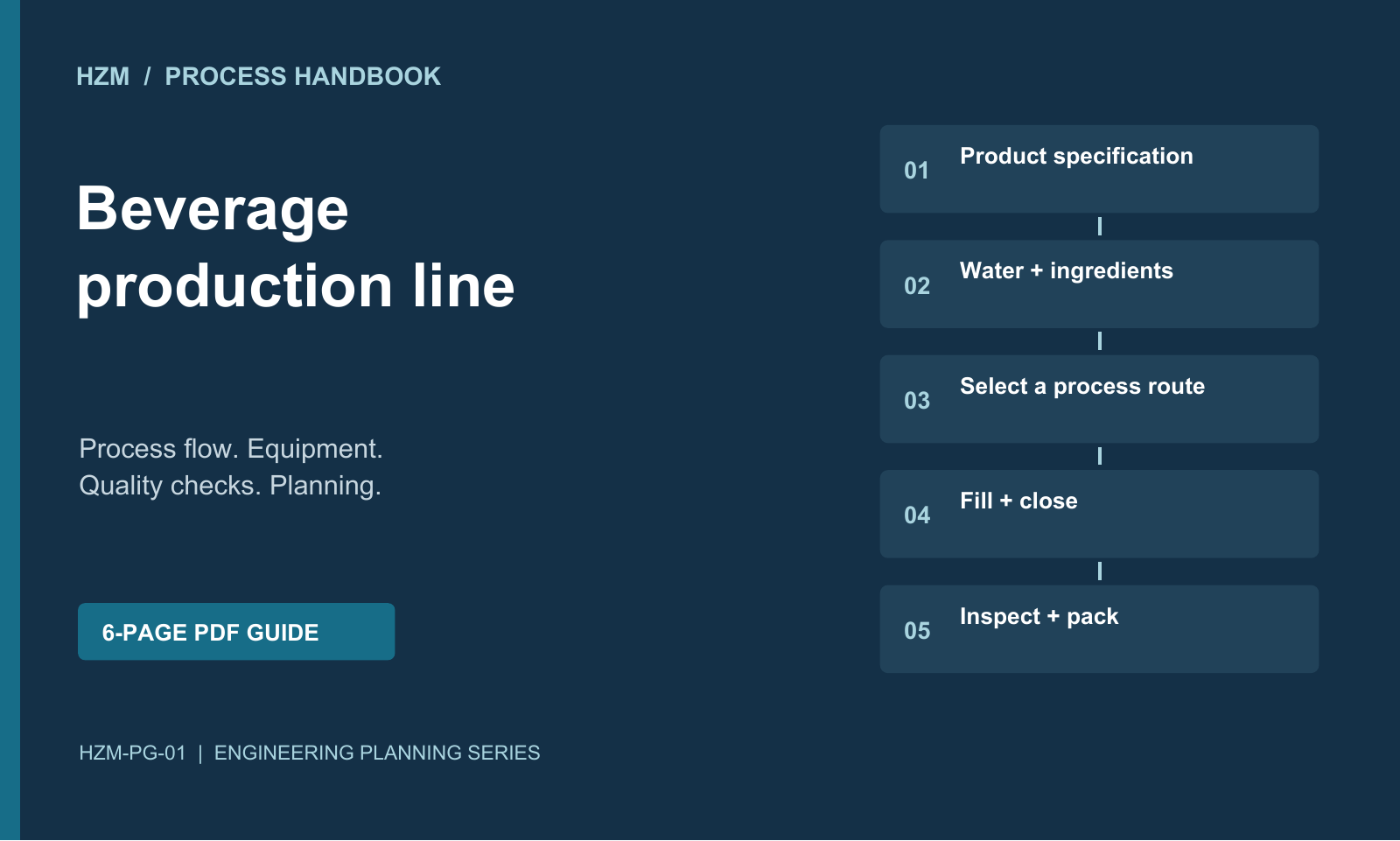
6-page technical guide · Original flow chart · Printable checklists
Scope: Still drinks, carbonated soft drinks and formulated juice beverages. Start here to choose the right production route.
Process map & project scope
A complete beverage production line starts with a finished-product specification and ends with released, traceable packs. The filler is only one part of that system. Raw-water quality, ingredient preparation, preservation, package design and secondary packaging must all support the same recipe and output target. This downloadable guide provides a planning flow chart, an equipment schedule and a practical worksheet for discussing a new line with suppliers.
Use this guide for early project definition rather than as a production recipe. A sugar-free carbonated drink, a pulpy juice and an unsweetened tea can share some utilities, but they do not automatically share the same preservation process or filling machine. Confirm the product family first; then develop a line configuration around the package and distribution conditions.
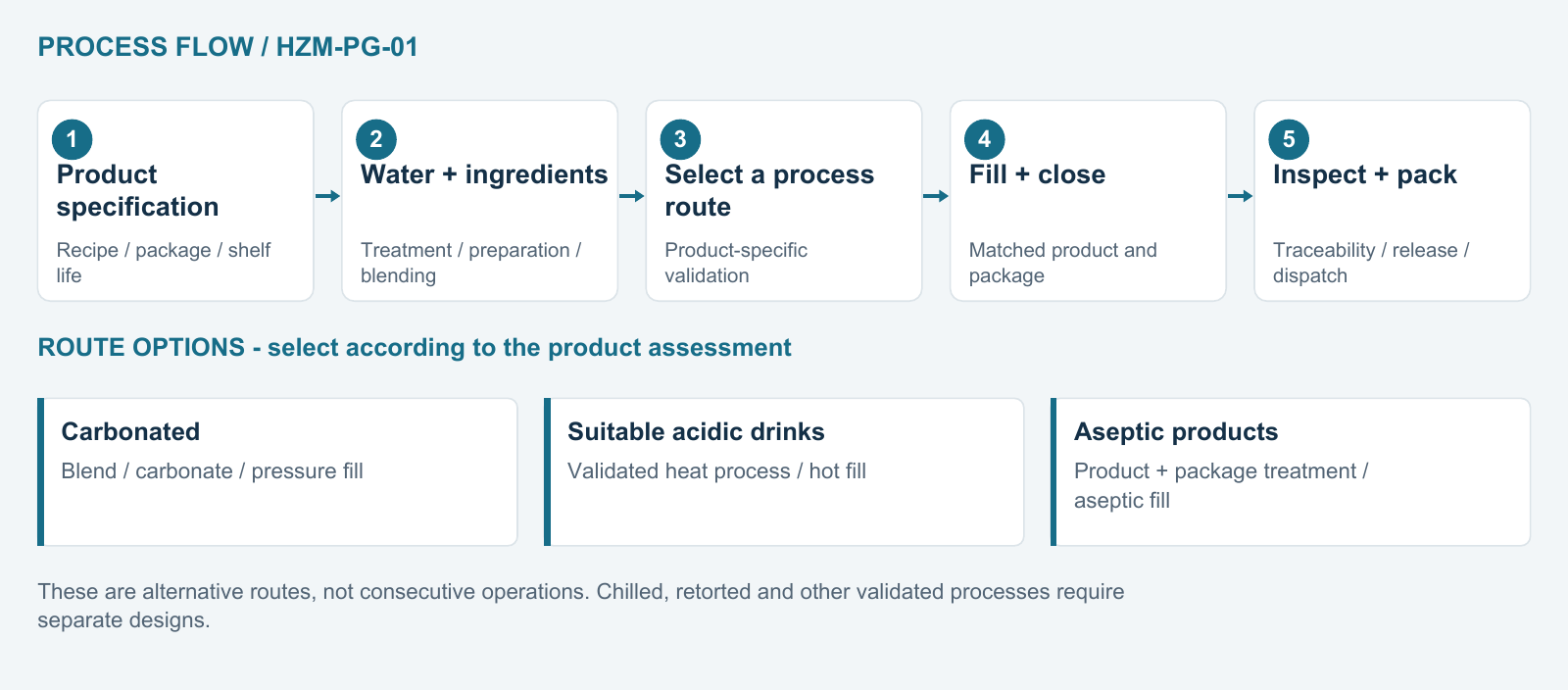
Read the process flow as text
- Product specification – Recipe / package / shelf life
- Water + ingredients – Treatment / preparation / blending
- Select a process route – Product-specific validation
- Fill + close – Matched product and package
- Inspect + pack – Traceability / release / dispatch
These are alternative routes, not consecutive operations. Chilled, retorted and other validated processes require separate designs.
From raw materials to finished packs
01 / Treat the water for its intended use
Obtain an actual source-water analysis, including seasonal variation where relevant. Specify product water separately from boiler feed, cooling water and cleaning water. Treatment may include filtration, hardness control, membrane treatment or other appropriate stages; buying reverse osmosis equipment without defining the required water quality can create unnecessary cost and waste.
02 / Prepare and verify the ingredients
Provide an approved receiving area, lot identification, weighing and controlled storage. Prepare sugar syrup, dissolve powders or meter liquid concentrates according to the recipe. Decide which ingredients need separate dissolving or pre-mixing equipment. Confirm the method for correcting a batch before it is released to the next stage.
03 / Blend and apply the selected process
Batch tanks suit many multi-recipe plants, while continuous dosing may suit long, stable production runs. Carbonated beverages need a defined gas-dissolution and pressure-filling route; suitable hot-filled products need a validated thermal and package-contact process. Aseptic production additionally requires a protected filling system and treated packaging. These differences affect equipment and operating procedures.
04 / Prepare containers, fill and seal
Purchased bottles, on-site PET blowing and can depalletizing need different infeed systems. Specify bottle necks, caps, seams, filling tolerances and change parts. Establish how containers and closures are prepared for the selected hygiene level. Ordinary rinsing should not be described as sterilization.
05 / Inspect, label, pack and release
Check closure integrity, fill level or mass, code legibility and label position. Group containers into the required pack, then palletize if the project calls for it. Separate rejected and unreleased stock from saleable goods. Link the packaging code to the ingredient lots, processing records and final quality decision.
Equipment schedule & line interfaces
| Area | Equipment to assess | Interface to confirm |
|---|---|---|
| Water and ingredients | Treatment, storage, dissolving, weighing | Water specification; batch and lot identity |
| Product processing | Mixing; route-specific thermal or carbonation equipment | Flow, pressure, temperature and hygienic boundary |
| Primary packaging | Container preparation, filler, capper or seamer | Package drawing; closure; change parts |
| End of line | Inspection, coding, labeling, packing, conveying | Pack format; reject handling; accumulation |
| Plant services | CIP, heating, cooling, compressed air, drainage | Peak demand and simultaneous users |
A useful equipment schedule includes the supplier, nominal duty, guaranteed duty for the actual product, utility demand, footprint and connection points for each machine. It should also say which company owns each interface. A conveyor gap, mismatched control signal or missing drain can delay a project even when every individual machine passes its factory test.
Request a capacity matrix for all planned bottle sizes and recipes. A speed quoted for water in a small bottle is not evidence of the same performance with a foaming beverage or a larger package. List format parts, cleaning constraints and minimum economical batch sizes alongside the headline speed.
Quality controls, hygiene & traceability
| Control area | What to record | Decision supported |
|---|---|---|
| Incoming materials | Supplier approval, lot, condition, test results | Accept, hold or reject |
| Blending | Recipe version, actual additions, Brix or other solids measure | Batch conformity |
| Preservation | Validated process settings and actual records | Product disposition after a deviation |
| Packaging | Closure tests, fill checks, inspection rejects | Package integrity and net contents |
| Cleaning | Circuit, time, temperature, chemistry and flow | Readiness for the next product |
| Finished stock | Lot code, retained samples, release results | Traceability and dispatch |
The table is a planning checklist, not a generic HACCP plan. A site-specific hazard analysis determines which steps are critical control points and which belong in prerequisite or quality programs. Assign a responsible person, an approved limit, a sampling method and an action for every monitored item. A number on a dashboard is useful only when operators know what to do if it moves outside its allowed range.
Design cleaning into the line
Map product-contact circuits, cleaning supply and return paths, valves, tanks and dead-end risks before installation. Cleaning effectiveness depends on the soil and circuit as well as the selected time, temperature, chemical conditions and mechanical action. Confirm compatibility with seals, instruments and packaging equipment.
Plan for interruptions
Define restart checks after loss of utilities, filler stoppage, incomplete cleaning or an abnormal product hold. Keep uncertain product identifiable while its disposition is assessed. The acceptance test should demonstrate alarm handling and segregation, not only steady-state speed.
Capacity worksheet & utility planning
Keep instantaneous running flow separate from average shift output. The upstream process must supply the running filler, while daily production also depends on cleaning, changeovers and planned downtime. If the 80% factor already includes quality losses, do not subtract those losses a second time. Write down the availability, speed and quality assumptions used in the calculation.
Batch and buffer sizing
At 6,250 L/h, a 3,000 L usable batch provides 28.8 minutes of product at nominal speed, ignoring losses. Compare that time with the next batch preparation, testing and transfer cycle. If preparation takes longer, assess parallel tanks or a different working volume. A buffer must also respect the product hold-time limit and the hygiene requirements of its position in the line.
| Service | Information to request |
|---|---|
| Heating | Peak load during start-up, production and cleaning; supply and return conditions |
| Cooling | Product heat load, ambient conditions, cooling duty and redundancy requirements |
| Compressed air / gases | Flow, pressure, quality at use points; simultaneous peak consumption |
| Water / drainage | Product, rinse and CIP demand; discharge temperature, chemistry and volume |
| Power / space | Connected and running loads; access, lifting routes and future expansion |
Ask vendors to state utility use per operating hour and per thousand saleable containers, together with the test conditions. Compare quotations on the same package, recipe and operating basis. A lower machine price can be offset by extra utilities, slower changeovers or equipment omitted from the supply boundary.
Commissioning checklist & common questions
- Approve product and package samples, the process description and the line capacity matrix.
- Agree factory and site acceptance tests using representative recipes and containers.
- Confirm process records, recipe access control, alarms and reject tracking.
- Train operators on cleaning, format changes and restart decisions.
- Verify finished-product specifications and shelf life before routine commercial release.
Can one line make water, juice and carbonated drinks?
Some equipment can be shared, but compatibility must be checked across product-contact design, filling method, package strength, hygiene and changeover. A flexible filler alone does not make the entire process suitable for all beverages.
Is PET blowing always part of a complete line?
No. A plant may buy empty bottles or blow them on site. Define this explicitly because a blower adds molds, preform handling, high-pressure air, cooling and operator requirements.
Does a faster filler increase daily output?
Only if upstream processing, packaging and operational availability support it. Compare good packs per shift and changeover performance, not just containers per hour during a short run.
What should accompany an RFQ?
Send the product list, recipe characteristics, bottle and closure drawings, output by format, annual demand, storage conditions, plant plan and utility information. Ask for an itemized scope with exclusions and measurable acceptance criteria.
Continue planning your line
- Beverage Filling Machine & Turnkey Filling Line for Juice, Soft Drinks and Cans
- Beverage Plant Utilities Checklist Before Equipment Installation
- FAT and SAT Checklist for a Turnkey Beverage Filling Line
- Bottled water production process PDF
More downloadable process guides
- Carbonated Soft Drink Production Process PDF: Syrup, Carbonation & Filling
- Juice Hot-Filling Production Process PDF: Flow Chart & Quality Checklist
- Ready-to-Drink Tea Production Process PDF: Extraction, Clarity & Filling
Talk to our engineering team
Need help planning your packaging line?
Share your product, bottle and capacity requirements for a practical equipment recommendation.
2026-09-21
Juice Hot-Filling Production Process PDF: Flow Chart & Quality Checklist
Get a juice hot-filling process PDF with a production flow chart, bottle and closure checks, equipment schedule, thermal-process questions and planning examples.
Learn more2023-09-14
Carbonated Beverage manufacturing process flow
The manufacturing process for carbonated beverages involves several key steps to create the characteristic fizz and flavor while ensuring product safety and quality.
Learn more2023-09-18
Bottled water production process PDF
The PDF document on the bottled water production process encompasses detailed information on how bottled water is manufactured, including a comprehensive description of production steps, illustrated process diagrams, and in-depth explanations of quality control methods.
Learn more2024-02-06
The process flow of mineral water production line
The production process of the mineral water production line includes mineral water treatment equipment, mineral water bottle blowing machine, fully automatic mineral water filling machine ...
Learn more
2023-05-02
The Secret of Juice Beverage Production Equipment and Process Flow
The juice production line is used for deep processing of various fruits to make delicious juice beverages. In recent years, the government has provided significant support for agricultural deep processing. Many fruits have gained greater added value after deep processing, such as pomegranate juice, seabuckthorn juice, blueberry juice, and more
Learn more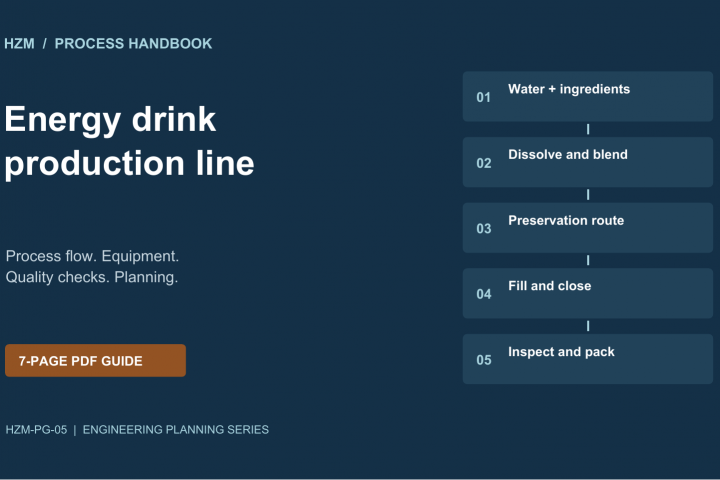
2026-09-21
Energy Drink Production Line Process PDF: Mixing, Filling & Quality Control
Download a complete energy drink production process PDF with ingredient dosing, mixing, carbonated and still routes, filling, equipment photos and quality checks.
Learn more