
Insights & Updates
Energy Drink Production Line Process PDF: Mixing, Filling & Quality Control
7-page technical guide · Original flow chart · Printable checklists
Scope: Water-based energy drinks, with carbonated and still alternatives. Milk-containing energy beverages require a separate process assessment.
Project scope & complete process map
An energy drink production line must deliver a consistent formulation as well as a sound package. The usual front end prepares treated water, dissolves bulk ingredients, adds verified premixes and blends the beverage. The downstream route depends on whether the drink is carbonated, how its preservation is achieved and whether it is sold in cans or bottles. This PDF follows the complete line from receiving to released packs.
Define product identity before selecting a filler. Sugar-containing and sugar-free formulas, clear and cloudy drinks, and different active-ingredient systems can impose different mixing, analytical and cleaning requirements. The term energy drink does not define a single recipe or prove that one preservation process suits every product. Agree the formula, package, storage conditions and desired shelf life as a connected specification.
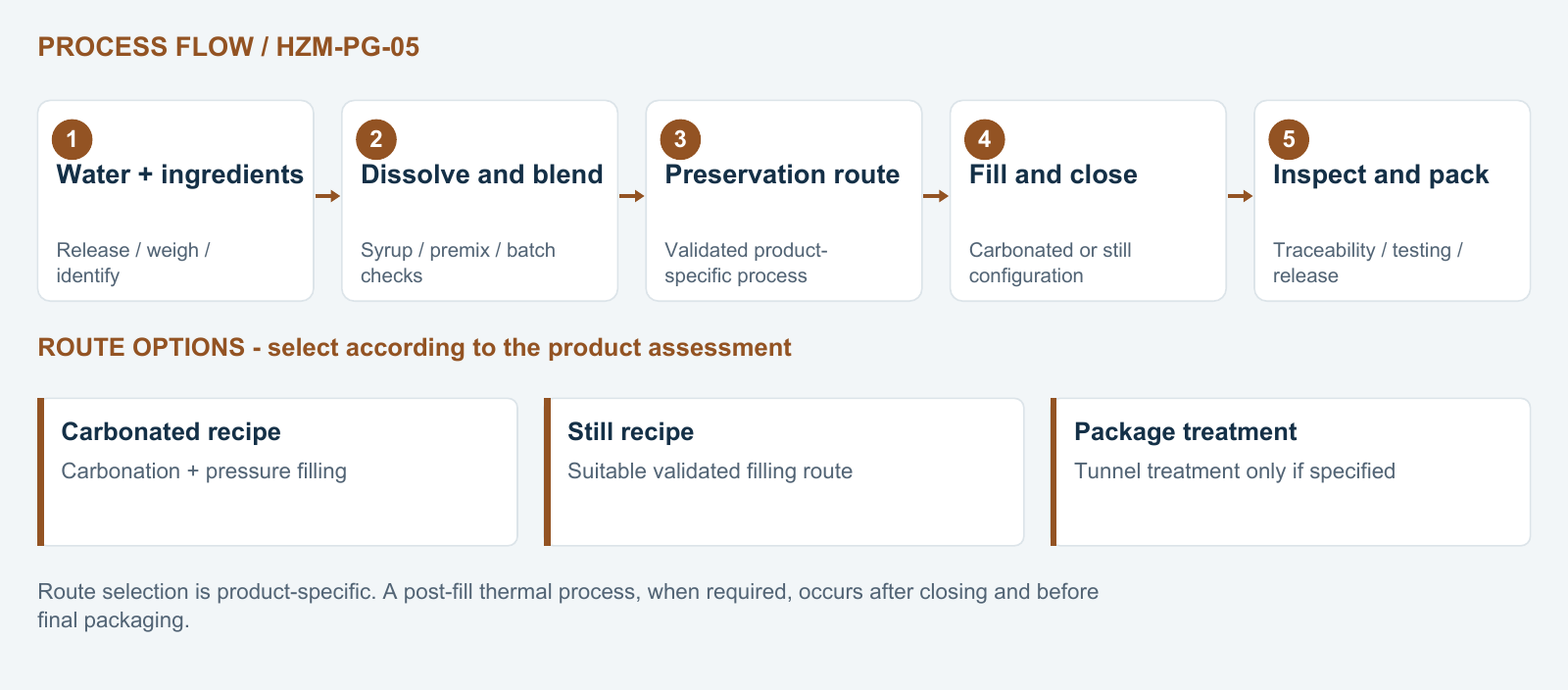
Read the process flow as text
- Water + ingredients – Release / weigh / identify
- Dissolve and blend – Syrup / premix / batch checks
- Preservation route – Validated product-specific process
- Fill and close – Carbonated or still configuration
- Inspect and pack – Traceability / testing / release
Route selection is product-specific. A post-fill thermal process, when required, occurs after closing and before final packaging.
Ingredient preparation & blending sequence
01 / Release ingredients and process water
Record supplier approval, ingredient identity, lot, expiry and storage condition. Review certificates against an agreed specification instead of treating every delivered lot as interchangeable. Separate the weighing of concentrated ingredients from bulk sugar handling. Water treatment should produce a repeatable flavor and chemical background for the chosen formula.
02 / Prepare the bulk syrup or liquid base
Granulated sugar needs appropriate dissolving capacity; liquid sweeteners use a different receiving and metering route. Set a repeatable addition order, working volume and mixing endpoint. A sugar-free formula may use much less bulk syrup but place greater demands on accurate low-rate dosing. Specify that case explicitly rather than assuming a sugar syrup system will handle it unchanged.
03 / Make and verify the minor-ingredient premix
Use scales suitable for the actual weighing range and an independent identity and quantity check. Include ingredient strength, carrier and certificate basis in the calculation. Controlled dilution into a compatible premix can help distribution, but the formulation specialist must confirm solubility and compatibility. Record additions and transfers so that missing or duplicate dosing can be investigated.
04 / Blend and release the finished batch
Establish agitation, addition order and a sampling method that demonstrates homogeneity. Check the recipe-specific attributes such as acidity, dissolved solids, appearance and relevant ingredient assays. Brix is not a substitute for caffeine or vitamin analysis and is not a direct measure of every sugar-free formulation. Keep nonconforming batches identifiable pending disposition.
05 / Preserve and carbonate where required
Select a validated preservation strategy for the final formula. Carbonated versions need controlled gas dissolution and an appropriate filler; still versions bypass carbonation. Industrial energy-drink can lines may include post-fill tunnel pasteurization, but this is an example of a configured route rather than a requirement for all products.
Filling, closure & equipment interfaces
| Area | Equipment to specify | Critical interface |
|---|---|---|
| Preparation | Water treatment, dissolver, premix and blend tanks | Ingredient accuracy; usable volume; batch release |
| Product route | Carbonator and cooling, or other selected process | Recipe; pressure; flow; preservation boundary |
| Primary pack | Bottle filler/capper or can filler/seamer | Package dimensions; closure quality; hygiene |
| After filling | Validated treatment if required, inspection, conditioning | Package thermal limits; treatment records |
| Dry end | Code inspection, labeler if needed, packer, pallet handling | Traceable code; pack format; good output |
For cans, include end supply, seamer configuration and seam inspection. For bottles, include the neck finish, cap, torque or other specified closure checks and leakage testing. Format drawings and physical samples should accompany the inquiry. A PET-bottle machine photo does not establish compatibility with cans, hot filling or an aseptic process.
Define how an upstream tank, mixer or carbonator responds when the filler slows or stops. Startup material and product held during interruptions need a documented disposition. Control interfaces should communicate ready, running, starved, blocked and fault conditions so that equipment does not operate as isolated machines.
Quality control & cleaning plan
| Checkpoint | Record | Why it matters |
|---|---|---|
| Weighing | Ingredient, actual amount, verifier, lot | Prevents dosing and identity errors |
| Blend release | Recipe version, representative samples, analytical results | Confirms the batch before filling |
| Preservation | Actual process records and deviation response | Supports the product safety decision |
| Package | Fill amount, closure integrity, code, rejects | Confirms a saleable and traceable pack |
| Shelf-life program | Sensory, ingredient stability, package and microbiological results | Supports storage and label claims |
Design an analytical plan around the recipe
Identify which ingredients need laboratory confirmation and at what stages. Define acceptance against the approved formulation and applicable market requirements. Include possible losses or instability during processing and storage; do not assume that the input amount is identical to the final packaged amount. Sample handling and method uncertainty belong in the specification.
Validate cleaning across the product range
Color, strong flavors, sweeteners and formulation residues may carry over to the next product. Map tanks, valves, transfer hoses, carbonator and filler circuits, then establish a suitable cleaning program and verification method. If an allergen-containing drink shares the line, include its specific controls and changeover requirements.
Investigate deviations systematically
For flavor variation, first reconcile ingredient identity, weighing and batch records. For sediment, investigate solubility and mixing before changing filtration. For foaming, review temperature, pressure and filling behavior. Preserve samples and associated settings, and change one relevant variable at a time.
Capacity worksheet & commissioning
Make sure the time basis includes the downtime you intend to model. Do not subtract cleaning or rejects twice if they are already included in the effective-output factor. Compare batch preparation, testing and transfer time with the available supply window. Parallel tanks may be needed when one batch cannot be completed before the previous batch runs out.
Premix and packaging balances
Calculate ingredient requirements from the approved mass-based formula, corrected for ingredient strength where appropriate. Reconcile actual premix made, transferred, retained and lost. At 12,000 cans/h in 24-can cases, the packer must support 500 cases/h at nominal line speed, before any agreed operating margin. Check the pallet pattern and pallet-handling cycle as well.
- Approve formula, pack drawings, raw-material specifications and analytical methods.
- Demonstrate accurate low-volume dosing and homogeneous mixing.
- Run representative products and formats at the guaranteed operating range.
- Verify closure integrity, package condition and readable lot coding.
- Demonstrate alarms, restart decisions and segregation of uncertain product.
- Record utilities and losses with the actual product and pack.
- Complete stability and release work before claiming commercial shelf life.
Ask for an itemized quotation covering processing, filling, packing, utilities, training and validation responsibilities. Distinguish supplier machine performance from the separate work needed to establish product compliance and shelf life.
Frequently asked questions
Is every energy drink carbonated?
No. Both still and carbonated products exist. A carbonated formula adds gas-dissolution and pressure-filling requirements. A still drink needs a suitable preservation and filling route rather than simply switching off gas on an unassessed line.
Can a soft-drink line be used?
It may be suitable after reviewing the formula, dosing precision, solubility, process conditions, package and cleaning program. The active-ingredient and stability requirements deserve explicit trials even when the basic machine arrangement resembles a CSD line.
Should vitamins be added after heat treatment?
Do not make that change as a general rule. The addition point affects both product stability and the hygienic boundary. An addition after a preservation step requires an appropriately designed and validated system.
Does carbonation preserve the drink?
Carbonation alone does not establish an adequate preservation process or shelf life for a particular formula. Assess the complete product, process, package and storage system.
What should an energy-drink RFQ include?
Provide formula characteristics, carbonation target if applicable, package samples, capacity by format, ingredient handling needs, storage conditions, utility availability and the required test plan.
Equipment photo references
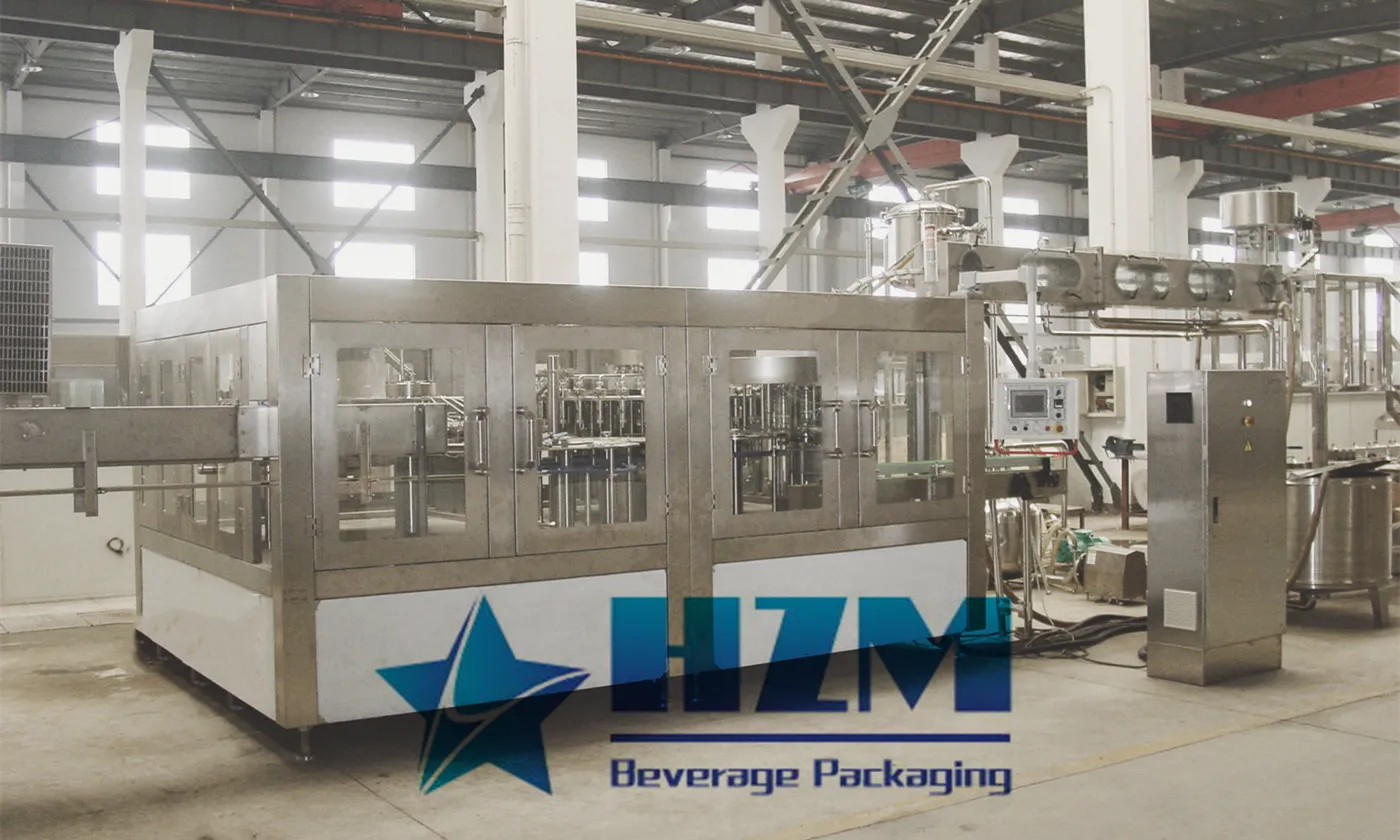
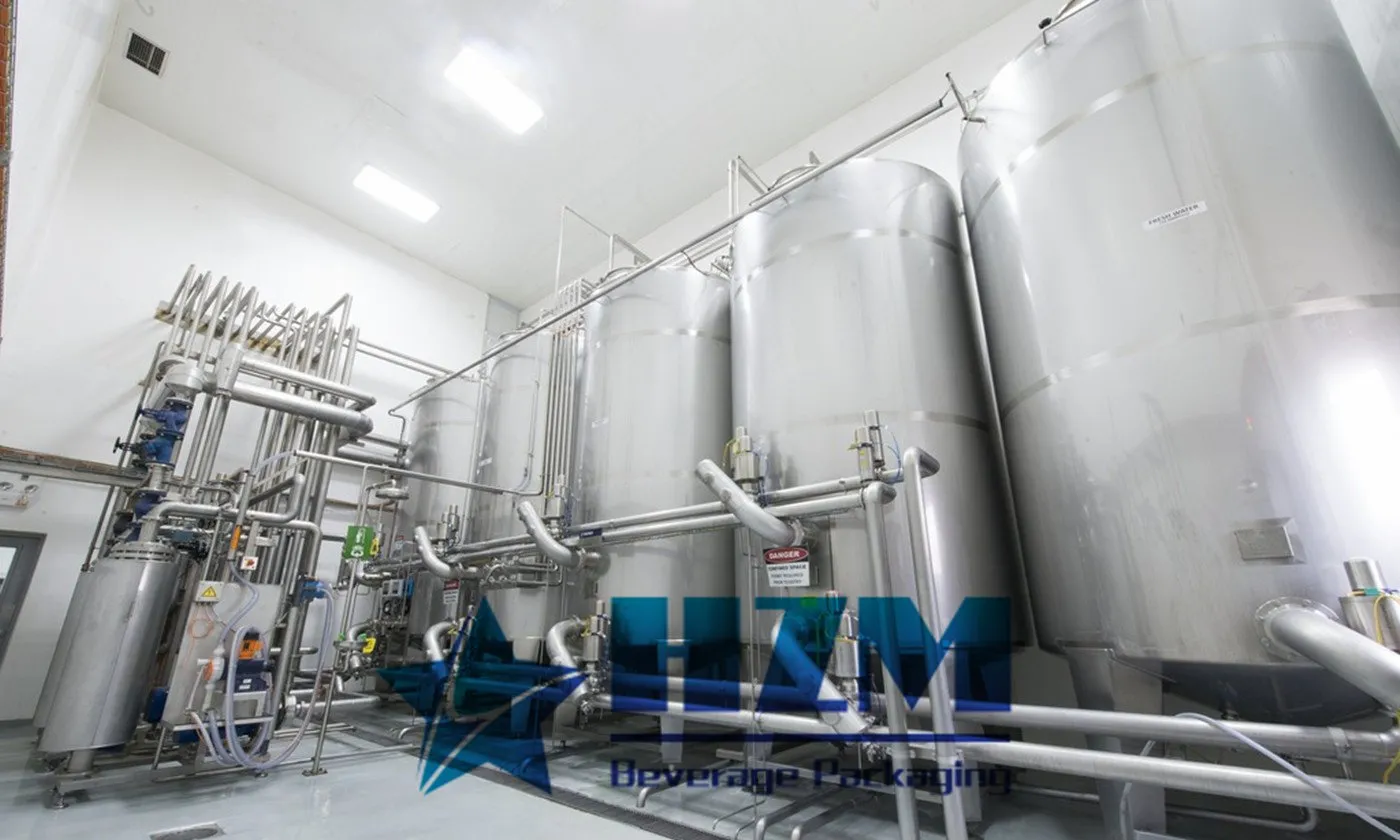
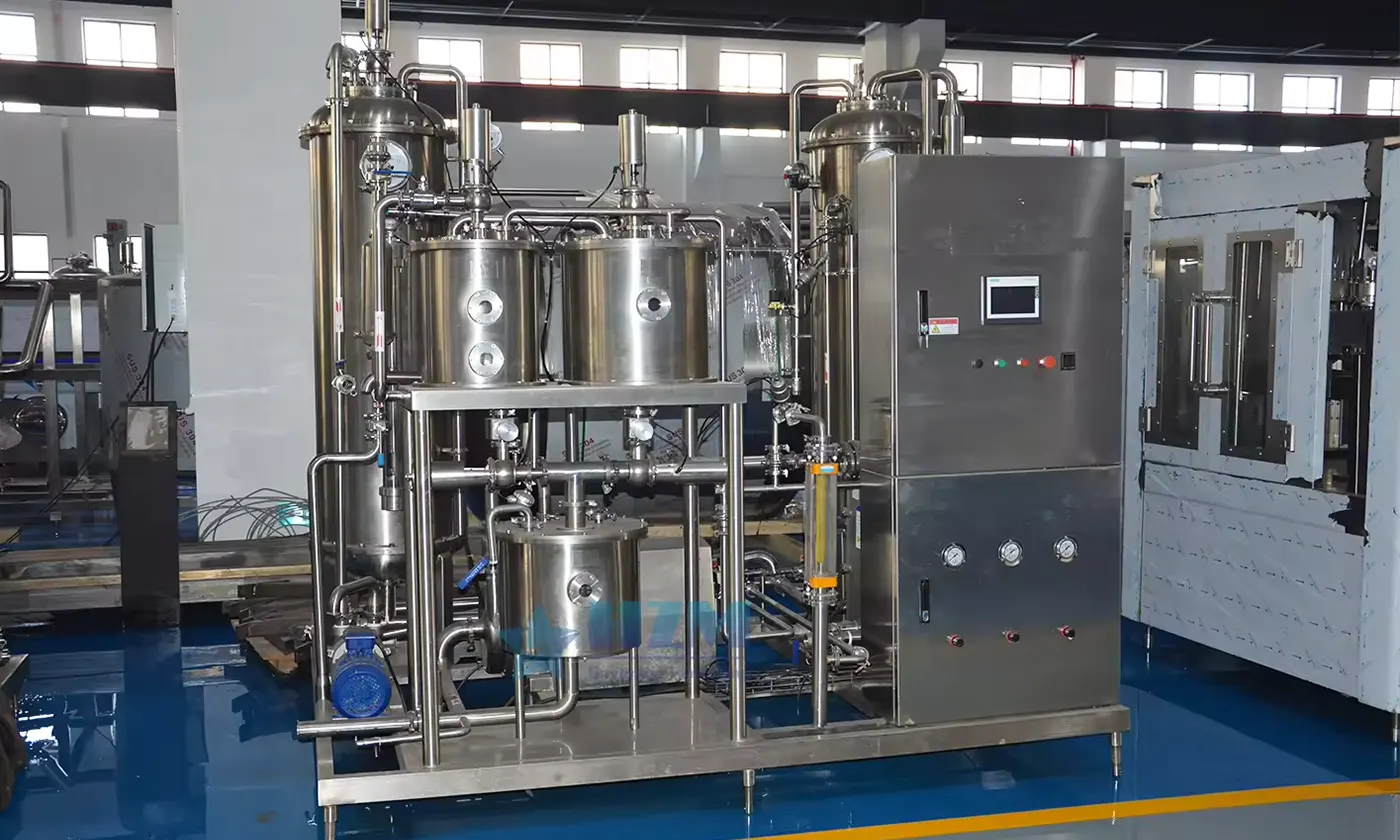
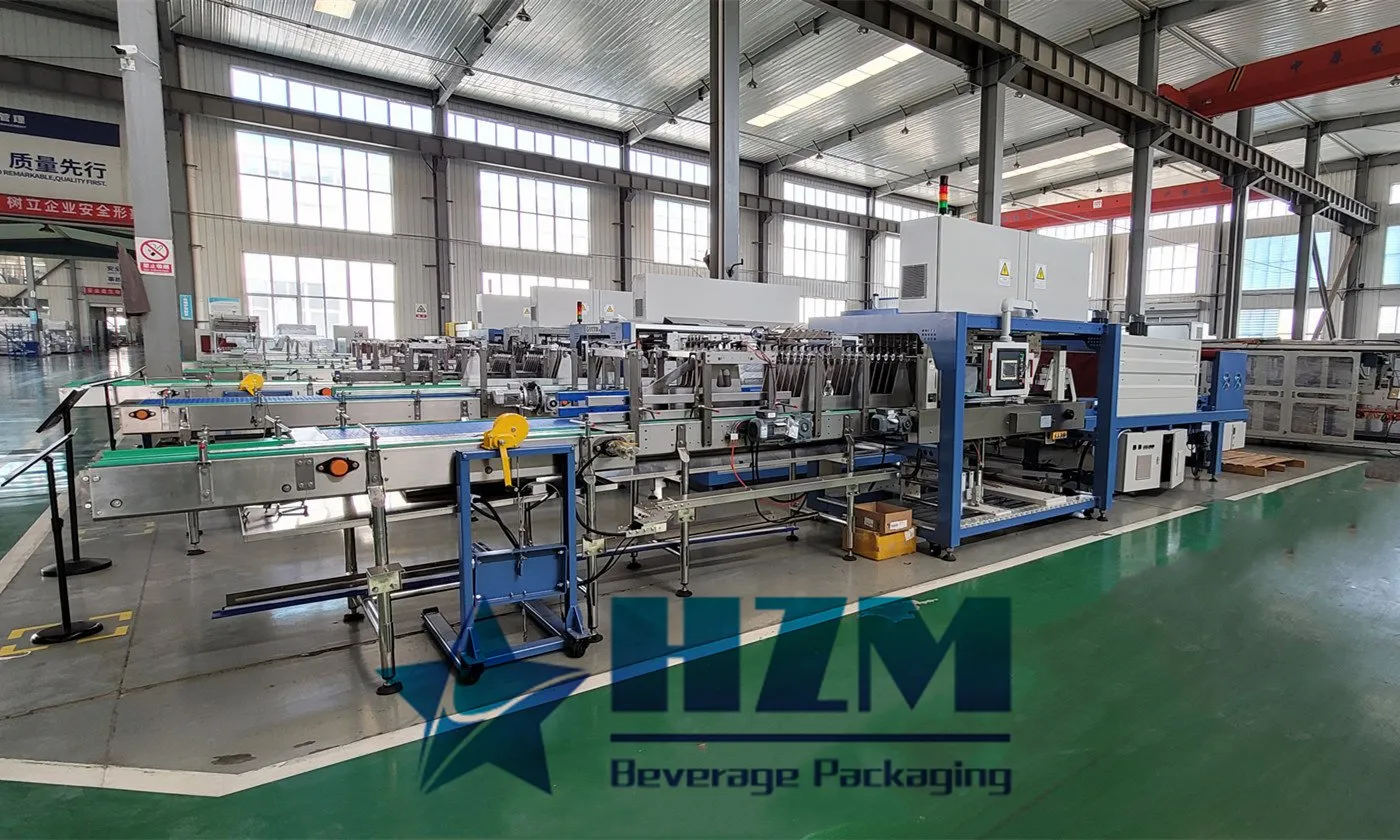
These selected media-library photographs identify real equipment categories. They are not a single installed energy-drink line and do not establish the final project specification.
Continue planning your line
- Beverage Filling Machine & Turnkey Filling Line for Juice, Soft Drinks and Cans
- Carbonated Drink Co2 Mixer Machine
- Carbonated Soft Drink Filling Machine
- Carbonated Soft Drink Production Process PDF: Syrup, Carbonation & Filling
More downloadable process guides
- Complete Beverage Production Line Process PDF: Flow Chart & Equipment Guide
- Carbonated Soft Drink Production Process PDF: Syrup, Carbonation & Filling
- Juice Hot-Filling Production Process PDF: Flow Chart & Quality Checklist
- Ready-to-Drink Tea Production Process PDF: Extraction, Clarity & Filling
- Natural Mineral Water Production Line Process PDF: Source to Bottle
- Drinking Water Production Process PDF: Well Water & Tap Water Purification
Talk to our engineering team
Need help planning your packaging line?
Share your product, bottle and capacity requirements for a practical equipment recommendation.

Equipment
PET Bottle Energy Drinks Filling Machine
The PET bottle energy-drink filling machine combines bottle rinsing, liquid filling and capping in an automatic system.
Learn more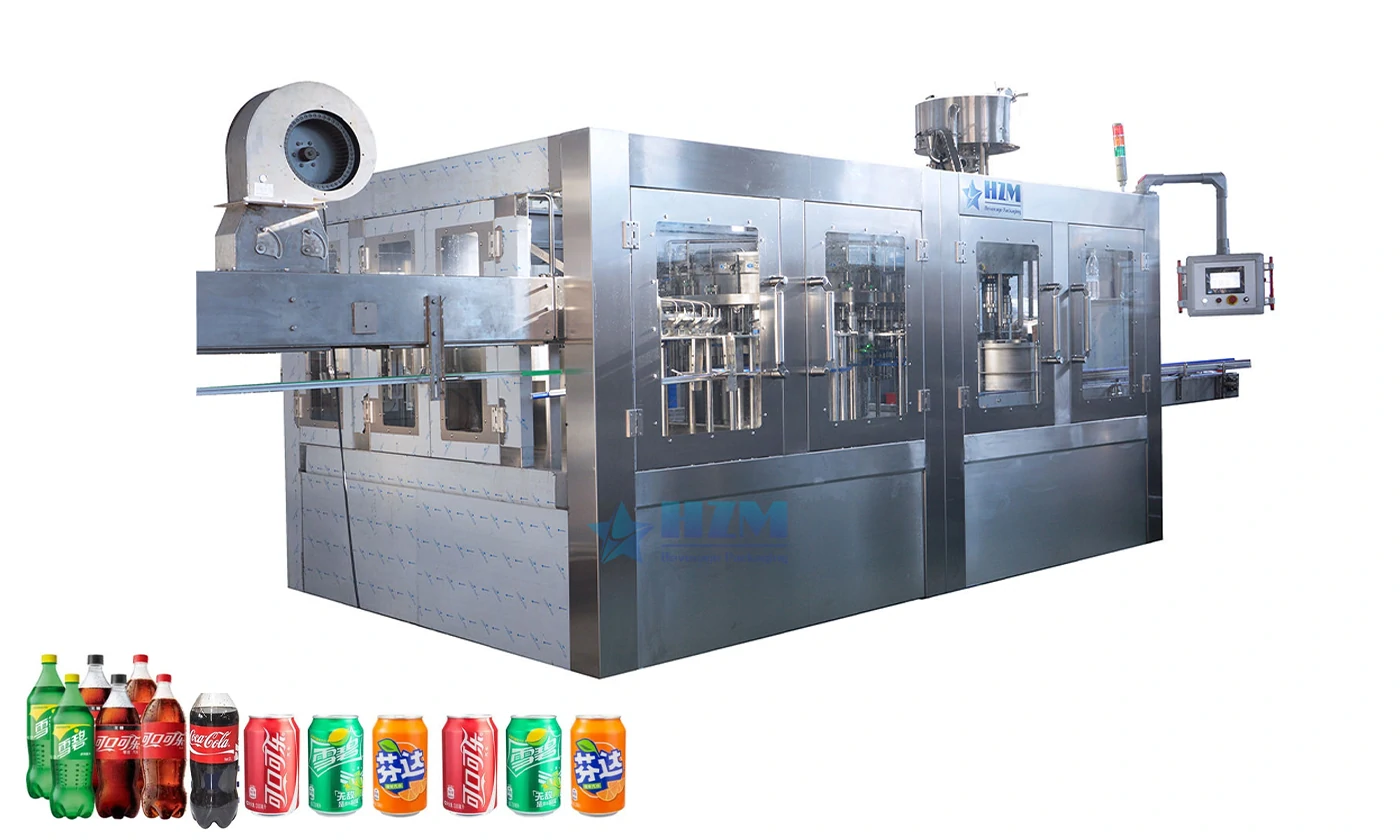
Equipment
Beverage Packaging Machine for Juice, Soft Drinks, Carbonated Drinks, and Energy Drink
HZM supplies beverage production and packaging equipment for juice, soft drinks, carbonated drinks and energy drinks.
Learn more
2023-12-11
Energy Drink Production Line for Sale by HZM Machinery
In the dynamic world of beverage production, HZM Machinery stands as a professional and dedicated manufacturer of Energy Drink production line equipment.
Learn more2023-09-18
Bottled water production process PDF
The PDF document on the bottled water production process encompasses detailed information on how bottled water is manufactured, including a comprehensive description of production steps, illustrated process diagrams, and in-depth explanations of quality control methods.
Learn more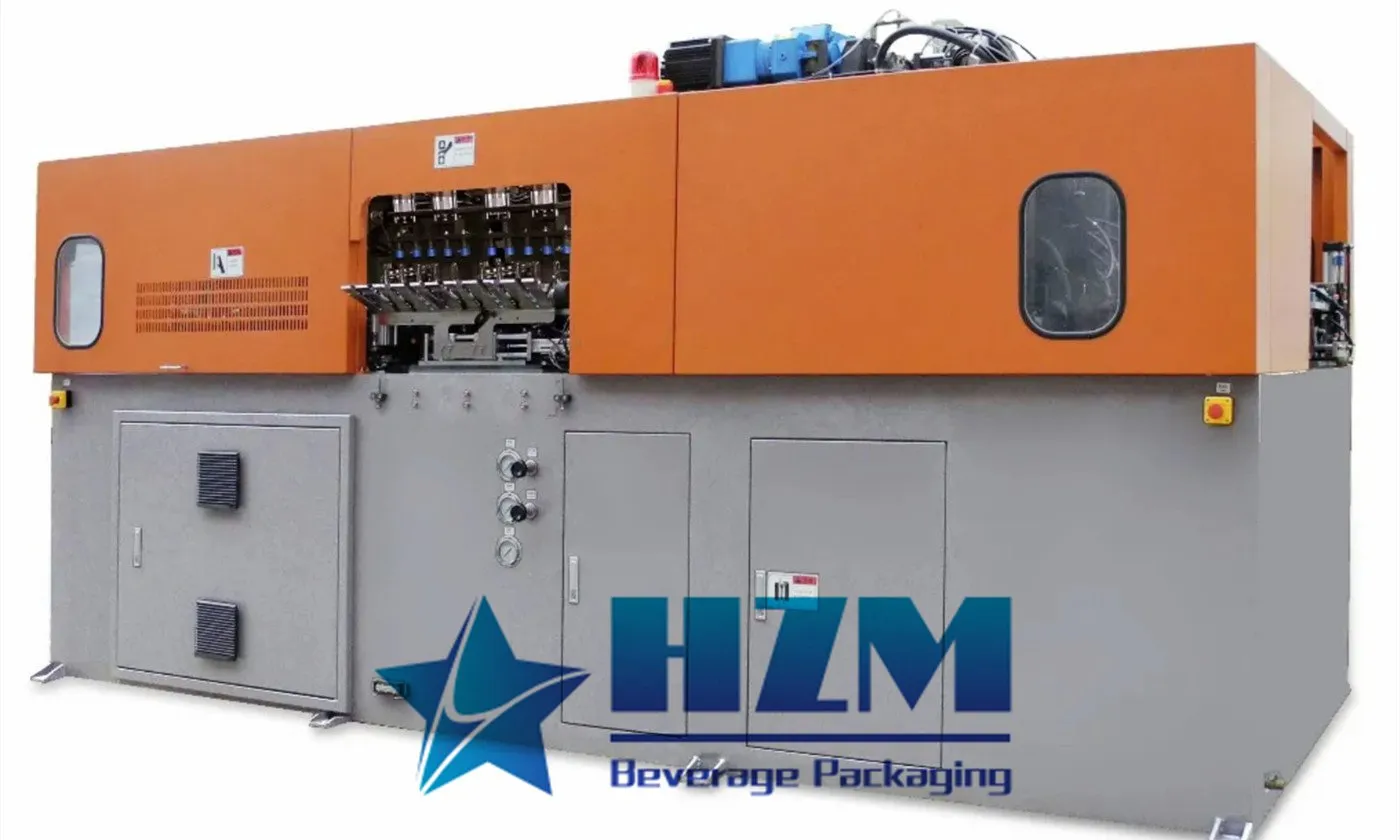
2023-06-09
PET Blow Molding System Guide: Servo Control and Energy Consumption
Practical HZM guidance on pet blow molding system, focused on servo control and energy consumption, line integration, RFQ data and measurable acceptance checks.
Learn more
2023-05-22
Leading Manufacturer of PET Bottle Energy Drinks Filling Machines
HZM Machinery is a leading manufacturer of PET bottle energy drinks filling machines, specializing in providing efficient and accurate filling equipment. This article introduces HZM Machinery's expertise in PET bottle energy drinks filling machines and highlights its competitive products.
Learn more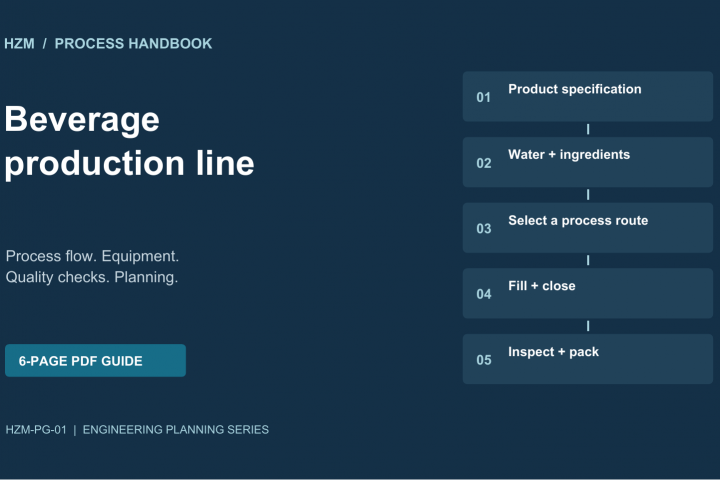
2026-09-21
Complete Beverage Production Line Process PDF: Flow Chart & Equipment Guide
Download a beverage production line process PDF with route-selection diagrams, equipment lists, capacity calculations, utility planning and commissioning checks.
Learn more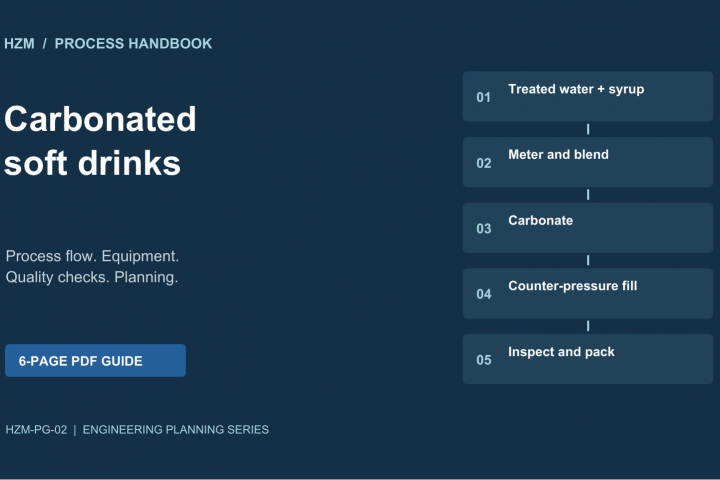
2026-09-21
Carbonated Soft Drink Production Process PDF: Syrup, Carbonation & Filling
Download a carbonated soft drink process PDF covering syrup preparation, blending, carbonation, counter-pressure filling, CO2 checks and line planning.
Learn more